
Reviewed · CIVIC DISTRICT & COLONIAL TOURS
Splendour of Colonial Singapore Walking Tour with Lunch
Singapore’s colonial story comes alive in the Civic District, where former government offices, courts, churches, bridges, and post offices now serve new purposes. This tour links them into one sensible walk, with guide Ping explaining how a British trading post founded in 1819 grew into modern Singapore.
I like the small group size, capped at 15, and the way the tour mixes outdoor landmarks with indoor stops. I also like the three-course lunch at Boat Quay, which gives you a proper break beside the Singapore River instead of leaving you to find food on your own.
The main thing to consider is the heat. Three and a half hours on foot can feel demanding in Singapore’s midday weather, though the route includes air-conditioned buildings and the guide is reported to adjust the pace when needed.
In This Review
- Key points to know before you book
- Why this tour gives colonial Singapore a clear shape
- Starting at St Andrew’s Cathedral
- Entering the former City Hall and Supreme Court
- The Arts House and Singapore’s oldest surviving building
- Victoria Theatre, Victoria Concert Hall, and the old government center
- Crossing Cavenagh Bridge to the Singapore River
- The Fullerton building and a former post office
- Three courses beside the river at Boat Quay
- Inside the former Supreme Court
- Central Fire Station and a look at old firefighting
- The Armenian Apostolic Church and the tour’s final story
- Ping’s guiding style and the value of a small group
- Is $55.61 a fair price?
- Who should book this walking tour?
- Should you book it?
- FAQ
- How long does the Colonial Singapore walking tour last?
- What time does the tour begin?
- Where does the tour start?
- Where does the tour finish?
- Is lunch included?
- Are vegetarian lunch options available?
- Is a guide included?
- What happens if it rains?
- How large is the group?
- Can I cancel the booking for a refund?
Key points to know before you book
- Ping is the guide to look for: She leads the tour in clear English, explains Singapore’s past and government, takes group photos, and shares them afterward through a Google Photos link.
- The route covers 10 important sites: You see churches, courts, civic buildings, a bridge, a former post office, a fire station, and the Singapore River.
- Lunch is part of the experience: A three-course meal at Boat Quay includes both vegetarian and non-vegetarian choices.
- The National Gallery stop has real substance: You visit the former City Hall and Former Supreme Court buildings, not just their exteriors.
- Indoor breaks matter: The route includes air-conditioned stops, useful during Singapore’s heat and humidity.
- The tour begins and ends near City Hall MRT: Start at 10 a.m. on North Bridge Road and finish at the Armenian Church on Hill Street.
Why this tour gives colonial Singapore a clear shape
Singapore’s colonial story can feel scattered if you see the buildings one by one. This walk gives the story an order. You begin with the arrival of Sir Thomas Stamford Bingley Raffles and the creation of a British trading post in 1819, then follow the growth of European settlement, civic administration, law, religion, transport, and communications.
The focus is not only on grand architecture. You also hear how Singapore became part of the Straits Settlements in 1826 and later a separate British crown colony in 1867. That wider frame helps you understand why so many formal buildings appeared in one compact district.
The tour also takes a favorable look at the colonial legacy, including town planning, legal systems, education, infrastructure, and architecture. That angle is worth keeping in mind. Colonial rule involved power and control, but the buildings and institutions left behind still shape Singapore’s civic center. A good guide can hold both ideas at once, and Ping’s approach places strong emphasis on how these systems contributed to the country’s development.
You spend about three and a half hours walking, listening, entering selected buildings, and stopping for lunch. The group limit of 15 is important here. In a larger crowd, details inside churches and public buildings can easily get lost. With a smaller party, it is easier to hear, ask questions, and stay together around busy streets.
More history and heritage around Singapore:
- Nightout at Colonial Charms of the City
★ 3.5 · 733 reviews - Of Graves, Guns & Battles™: A Tour of Fort Canning Hill
★ 5.0 · 106 reviews - Splendour of Colonial Singapore Walking Tour with Lunch
★ 5.0 · 82 reviews
Starting at St Andrew’s Cathedral
The meeting point is City Hall MRT Station, at 150 North Bridge Road, and the start time is 10 a.m. From there, the first stop is St Andrew’s Cathedral, where the story begins with the early European settlement and the first Anglican church built in Singapore.
The present church dates from 1836, making it an early marker of British influence in the city. This is a short 15-minute stop, so expect an introduction rather than a long visit. It works well as an opening because it connects people, faith, and settlement before the tour moves on to official buildings.
If you arrive by public transport, the starting point is convenient. Wear shoes suited to walking, and bring water. A disposable poncho is provided if rain arrives, but light clothing and sun protection are still sensible choices.
Entering the former City Hall and Supreme Court
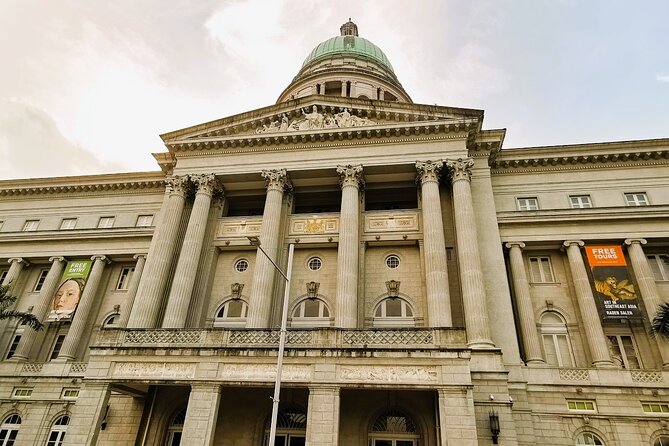
The National Gallery Singapore is the tour’s most substantial architectural stop, with about 40 minutes devoted to the two former colonial buildings that now form the gallery.
One was the Former Municipal Building, later renamed City Hall. The other was the Former Supreme Court Building. Their new role as an art gallery is interesting in itself, but the focus here is on the old civic functions and the design of the buildings.
This is where the tour moves beyond looking at facades. You step into spaces connected with government and justice, and you can better understand how the colonial city was organized. The buildings also provide a welcome air-conditioned break, an important practical detail in Singapore.
The tour does not appear to include a full art-gallery visit or dedicated exhibition time. If you want to study the art collections at length, you would need a separate visit. Here, the value comes from seeing the former public buildings as part of Singapore’s civic story.
The Arts House and Singapore’s oldest surviving building
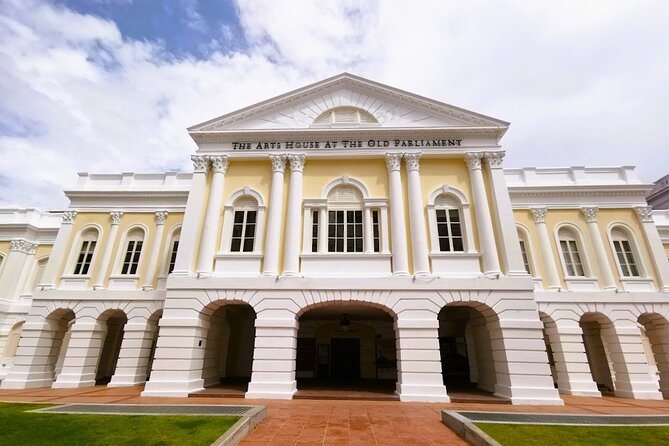
The Arts House occupies the oldest surviving building in Singapore, dating from 1827. The stop lasts about 20 minutes and is designed to reveal details that are easy to miss if you pass by without a guide.
The building’s present cultural role gives it a second life, but its early purpose helps explain the shape of the old European Town. This is one of the tour’s better moments for people who enjoy architecture with a story attached. You are not simply told that a building is old. You learn how it fitted into the young trading settlement.
The tour keeps moving at this point, so you will not have unlimited time to wander. That is a fair trade for seeing many places in a single morning.
A few more Singapore days out worth weighing up
- Singapore: Chinatown Historic Walking Tour with Lunch
★ 5.0 · 134 reviews - Singapore’s Historic Chinatown Walking Tour with Lunch
★ 5.0 · 37 reviews - SMALL GROUP: Batam day tour with Ferry, 1-hour Massage, and Lunch from Singapore
★ 4.0 · 29 reviews - Singapore to Batam:City Tour with Ferry Tickets & Lunch
★ 4.0 · 22 reviews
Victoria Theatre, Victoria Concert Hall, and the old government center
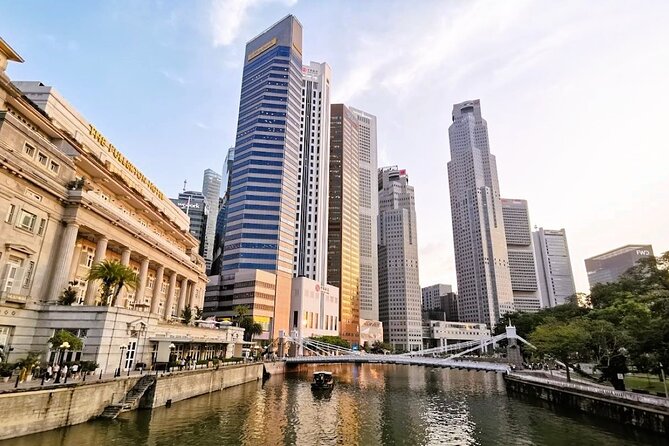
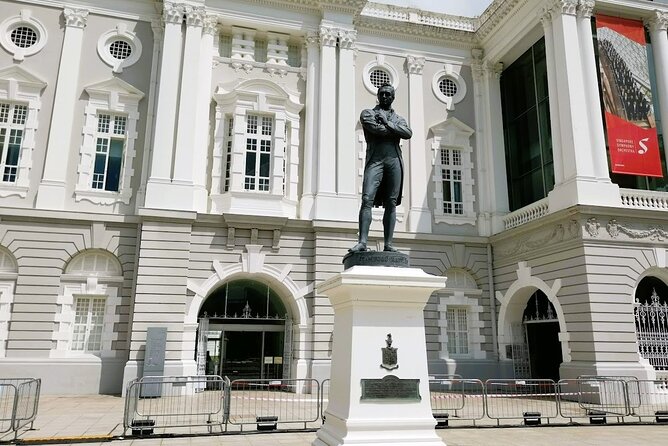
The Victoria Theatre and Victoria Concert Hall show how Singapore adapted existing buildings over time. One began as the Town Hall, while the other was built more than 40 years later as a Memorial Hall for Queen Victoria. They were eventually joined into one complex.
The stop lasts around 10 minutes, enough to explain the relationship between the buildings and point out the original bronze statue details mentioned in the tour description. It is a brief architectural pause rather than an indoor performance or concert visit.
The route also passes the former Government Offices of Colonial Singapore. This short section helps connect the ceremonial buildings with the everyday machinery of administration. You get a sense of a planned civic district, where courts, offices, churches, and public halls were placed close together.
Crossing Cavenagh Bridge to the Singapore River
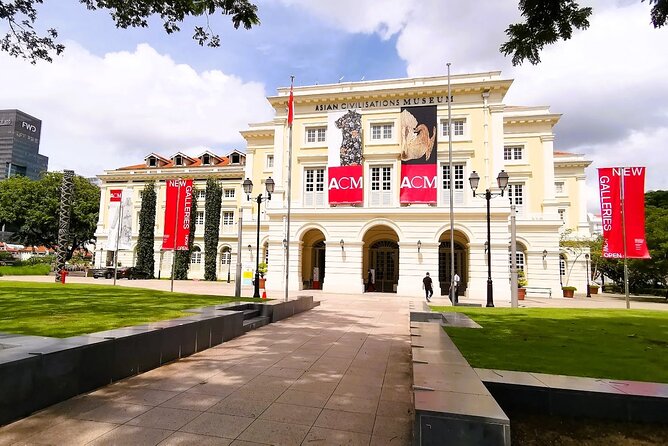
Cavenagh Bridge is the oldest surviving suspension bridge in Singapore. You cross it on foot and hear about life along the Singapore River roughly 200 years ago.
This is a useful change of pace. After several formal buildings, the bridge puts you in the middle of the old transport and trading corridor. The river was central to Singapore’s growth, and the bridge helps you picture how movement across the water shaped the city.
The stop is short, about 10 minutes, but the bridge also functions as part of the walk to Boat Quay. Depending on the weather and crowd levels, this may be one of the more exposed sections of the route. Keep your phone and camera ready, but do not expect a long photo session at every point.
The Fullerton building and a former post office
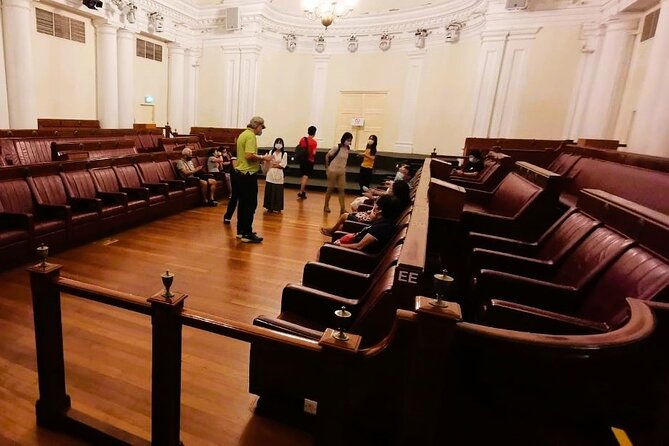
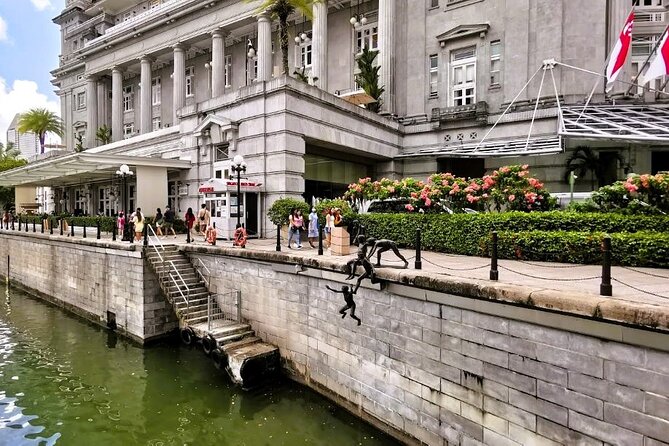
The Fullerton Shop is located in the building that once housed Singapore’s General Post Office. Today, the building is The Fullerton Hotel, a five-star property with a heritage gallery.
This is a nice example of adaptive reuse. A place once tied to letters, parcels, and official communications now serves as a luxury hotel, while still presenting its past through heritage displays. You have about 15 minutes here, enough for a quick look and an explanation of the building’s former role.
It is also a reminder that colonial Singapore was not only about government. Postal services, shipping, trade, and communications were essential to the port’s growth. The tour does a good job of using buildings to show those different parts of city life.
Three courses beside the river at Boat Quay
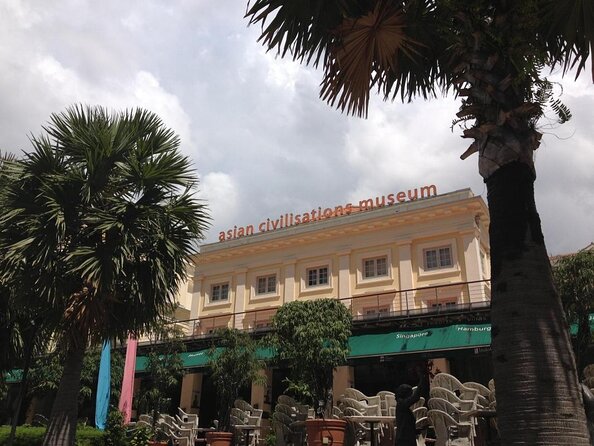
Around midday, you stop at Boat Quay for a three-course lunch at a riverside restaurant. Vegetarian and non-vegetarian options are available, and lunch is included in the tour price.
This is more than a convenient meal break. Boat Quay gives you time to sit beside the Singapore River and connect the earlier discussion about trade and transport with the setting itself. It also lets you talk with Ping and the other people in your group rather than listening continuously while walking.
The lunch lasts about 40 minutes. That is enough for a proper pause, though not a leisurely long meal. If you have strict dietary requirements beyond the stated vegetarian and non-vegetarian choices, the supplied information does not confirm how they are handled, so ask before booking.
Several tour comments single out the lunch location and food as a strong part of the day. I can see why. At $55.61 per person, a three-course meal helps the price make more sense, especially in central Singapore where eating beside the river can cost a fair amount on its own.
Inside the former Supreme Court
After lunch, the tour returns to the civic district for another look at the Supreme Court. This is described as a maximum-security building with a spaceship-like structure on top, a reference to the modern structure associated with the present court complex.
The stop lasts around 25 minutes and offers a chance to explore the inside rather than only admire the exterior. It is a useful contrast with the older neoclassical buildings earlier in the route. You see how Singapore’s legal institutions developed from colonial foundations into a modern system.
The route also includes an iconic neoclassical colonial building with rainbow-coloured windows. The supplied details do not give its name, but the feature offers a striking visual break from the white stone and formal lines found elsewhere in the Civic District.
Central Fire Station and a look at old firefighting
Central Fire Station is Singapore’s oldest surviving fire station. Here, you come face to face with an antique horse-drawn fire truck and can climb aboard a vintage fire engine.
This stop gives the tour a more everyday feel. Courts and government halls can seem remote, but fire protection affected ordinary homes, businesses, and streets. The old equipment makes the subject easy to picture, especially if you are traveling with children or prefer practical history to long architectural lectures.
About 20 minutes is scheduled here. That should give you time to see the vehicles and hear how the station fits into the city’s development. It is not a full museum visit, so think of it as a focused stop within a broader walk.
The Armenian Apostolic Church and the tour’s final story
The final stop is the Armenian Apostolic Church of St. Gregory the Illuminator on Hill Street. Dating from 1835, it is Singapore’s oldest church and a place to learn about the Armenian community’s contributions to the country.
Ending here works well because it broadens the tour beyond British institutions. Singapore’s growth depended on many communities, not only colonial officials. The church gives Ping a chance to discuss one of the smaller but significant groups that helped shape the city.
The tour ends at 60 Hill Street, a short walk from City Hall MRT Station. That makes it easy to continue sightseeing, return to your hotel, or connect with another part of central Singapore.
Ping’s guiding style and the value of a small group
The strongest thread running through the tour is Ping’s guiding. She leads in English and is praised for clear explanations, good pacing, friendly treatment of solo participants, and careful attention to group safety.
She also takes photos at stops and sends a Google Photos link afterward. That is a thoughtful extra, particularly if you are traveling alone and want a few pictures of yourself in the Civic District.
Her subject range is broad. You can expect information about Singapore’s origins, architecture, culture, politics, government structure, and development. The tour is not just a sequence of dates. It aims to connect buildings with the people and institutions that used them.
The maximum group size is 15. That is not a private tour, but it is small enough for questions and conversation. The format suits you if you prefer a guide who explains as you walk rather than handing you a headset or leaving you to read plaques.
Is $55.61 a fair price?
At $55.61, this tour sits above a basic free walking tour, but it includes a licensed guide, a three-course lunch, and a route covering many major sites. Several stops are free admission, so the price is paying mainly for the guiding, organization, and meal rather than entry tickets.
For a first visit, the value is strongest if you want context. You can see many of these buildings independently, but you may not understand how the former government offices, courts, river, churches, fire station, and post office fit together.
The price is less compelling if you want long visits inside each building, extensive museum time, or a slow lunch. The itinerary is full, and the schedule keeps you moving. You are buying a well-organized introduction, not a day spent in one museum.
Who should book this walking tour?
I would choose this tour if you have limited time in Singapore and want a strong introduction to the Civic District. It is especially useful for solo visitors, first-time visitors, architecture fans, and anyone interested in how Singapore’s government and institutions developed.
It also suits people who like a guide with a personal connection to the country. Ping’s enthusiasm for Singapore comes through in the way she explains the city and answers questions.
You may want a different experience if you dislike walking in heat, need a very slow pace, or want a food tour focused on local dishes. Lunch is included, but the main subject is colonial Singapore, not Singaporean cuisine.
The tour is recommended for most participants, is near public transportation, and has free cancellation up to 24 hours before the start time. Gratuities are not included, so plan to tip separately if you feel the guiding deserves it.
Should you book it?
Book this tour if you want the Civic District to make sense rather than simply look impressive. The combination of Ping’s clear storytelling, indoor stops, small group, historic buildings, and riverside lunch makes it a practical half-day choice.
Skip it if your priority is independent museum time or a relaxed meal with no fixed schedule. For everyone else, especially with only a day or two in Singapore, this is a well-priced way to connect the city’s colonial past with the modern place you see today.
FAQ
How long does the Colonial Singapore walking tour last?
The tour lasts approximately 3 hours and 30 minutes.
What time does the tour begin?
It begins at 10 a.m.
Where does the tour start?
The meeting point is City Hall, at 150 North Bridge Road, Singapore 179100. It is close to City Hall MRT Station.
Where does the tour finish?
The tour ends at the Armenian Apostolic Church of St. Gregory the Illuminator, at 60 Hill Street, Singapore 179366. The church is a short walk from City Hall MRT Station.
Is lunch included?
Yes. The tour includes a three-course lunch at a riverside restaurant at Boat Quay.
Are vegetarian lunch options available?
Yes. Vegetarian and non-vegetarian lunch options are available.
Is a guide included?
Yes. A licensed tourist guide is included. The guide identified for this experience is Ping.
What happens if it rains?
A disposable poncho is included in case of rain.
How large is the group?
The maximum group size is 15 participants.
Can I cancel the booking for a refund?
You can cancel for a full refund if you cancel at least 24 hours before the experience start time. Cancellations or changes made less than 24 hours before the start time are not accepted for a refund.
More Walking Tours in Singapore
- Singapore: Private Walking Tour with a Local
★ 4.7 · 410 reviews - Private Customised Singapore Walking Tour
★ 5.0 · 370 reviews - Singapore: Chinatown, Little India, Arab Street Walking Tour
★ 4.9 · 207 reviews - Singapore: Chinatown and Little India Guided Walking Tour
★ 4.8 · 190 reviews
Just added around Singapore
- Marina Bay Sands SkyPark Observation Deck ticket in Singapore★ 4.0 · 3 reviews
- Singapore Private Full-Day Sightseeing Tour★ 5.0 · 3 reviews
- Skyline Luge and Sky Ride Ticket Sentosa Singapore★ 3.5 · 3 reviews
- Singapore: Food and Bike Tour – Downtown★ 4.6 · 3 reviews
- Singapore: Chinatown Street Food Tour★ 5.0 · 3 reviews
- Learn to cook authentic Peranakan food with local market tour★ 3.5 · 3 reviews
- Singapore Brompton Bike Tour from Rail Corridor, with food!★ 5.0 · 3 reviews
- Guided Walking Tour to the Historical Attractions in Farrer Park★ 5.0 · 3 reviews
Civic District & Colonial Tours, compared.

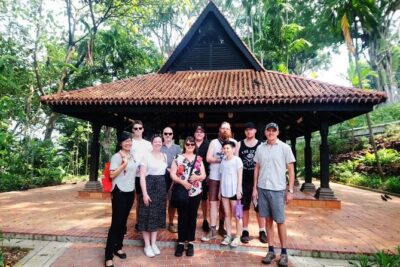
Of Graves, Guns & Battles™: A Tour of Fort Canning Hill
Read our review →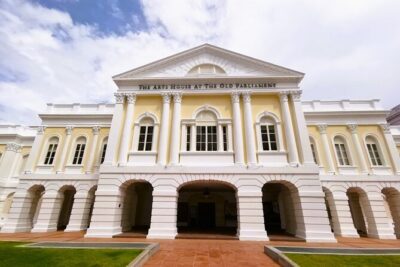
Splendour of Colonial Singapore Walking Tour with Lunch
Read our review →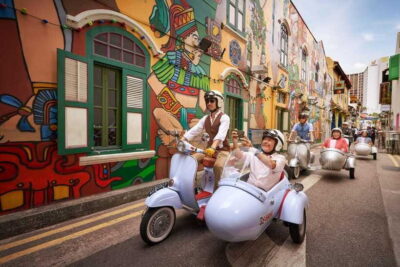
Kampong Glam & Civic District Vespa Sidecar Ride
Read our review →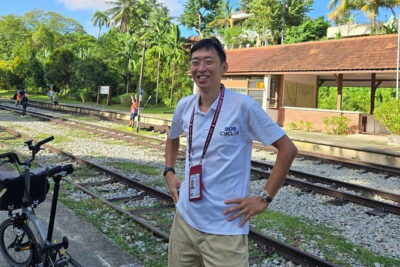
Singapore Cycling Tour – Rail Corridor, Civic District, & Food!
Read our review →
Browse the lists this tour appears in