
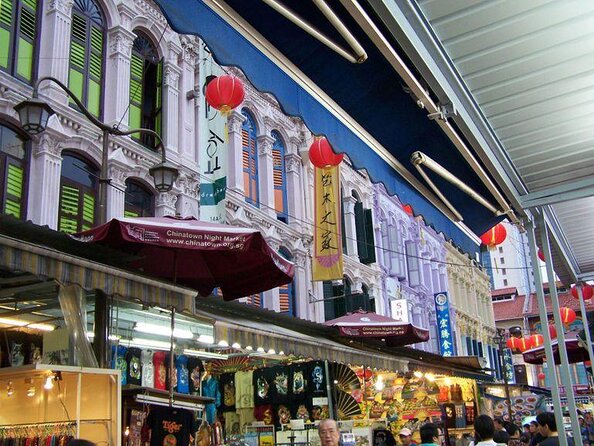
Reviewed · CHINATOWN TOURS
Streets Alive Singapore Walking Tour (Chinatown Edition)
Singapore’s Chinatown becomes a stage on this 2.5-hour walking tour, where live performers and virtual reality add a playful layer to temples, old streets, and city-planning stories. I like the mix of traditional culture and modern technology, and I like that the group is capped at 15 people. The main drawback is the strict no-refund policy, plus one reported booking problem involving unclear meeting instructions and an unanswered phone call.
I also like the route itself. It connects Telok Ayer, historic Chinatown, Sago Lane, and Smith Street instead of keeping you inside a single attraction. The tour costs $129, so you are paying for the guided production and technology, not simply a walk between free sights.
In This Review
- Key points to know before booking
- What Streets Alive is trying to do in Chinatown
- Starting at Telok Ayer
- Thian Hock Keng Temple and the first VR scene
- Singapore City Gallery and the city’s physical story
- Sago Lane and the Buddha Tooth Relic Temple
- A finish at Nanyang Old Coffee
- Is $129 a fair price?
- Who will enjoy this format most?
- How to prepare for a smoother outing
- Should you book Streets Alive Singapore?
- FAQ
- Where does the Streets Alive Singapore Walking Tour begin?
- Where does the tour end?
- How long does the tour last?
- How many people can join the tour?
- What sites are included?
- Is admission to the listed stops included?
- Does the tour include virtual reality?
- Does the tour use live performers?
- Can I cancel or change the booking?
Key points to know before booking
- Live performers add a theatrical twist: Characters appear during the tour and help carry the mystery and storytelling.
- Virtual reality is used at Thian Hock Keng Temple: The headset experience connects the temple to Singapore’s past in a sensory way.
- The route covers three distinct stops: You visit Thian Hock Keng Temple, Singapore City Gallery, and Buddha Tooth Relic Temple.
- The group is limited to 15 people: That should make it easier to follow the guide and take part in the interactive portions.
- The tour begins at Telok Ayer and ends on Smith Street: The finish is at Nanyang Old Coffee, in the center of Chinatown.
- The $129 price needs careful thought: The sights themselves list free admission, so the value depends on how much you want the performers, VR, and guided storytelling.
What Streets Alive is trying to do in Chinatown
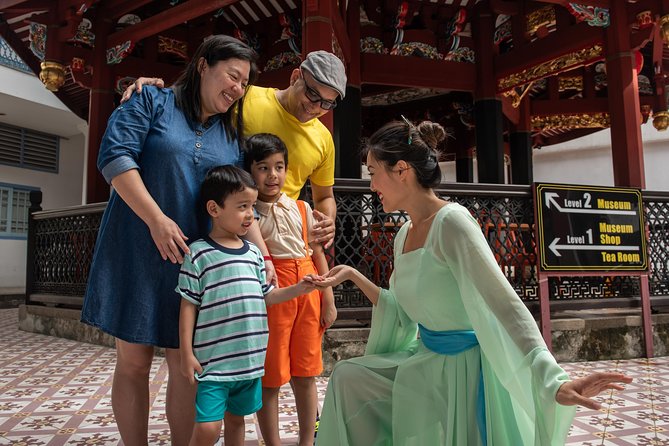
This is not a standard historical walk. Streets Alive Singapore uses Chinatown as a real-world setting for a small piece of live theater, then adds virtual reality and guided interpretation.
That combination matters because Singapore can sometimes feel polished and highly organized to the point that its older stories get overlooked. Here, the tour tries to put those stories back in front of you. You are not only looking at a temple facade or walking down an old lane. You are also given a character, a scene, or a digital view intended to help explain what the place meant.
The result should appeal most to you if you enjoy history with a bit of showmanship. If you prefer a quiet, traditional walk led by a local guide, the live-action elements may feel like too much decoration. The tour’s appeal rests on its unusual format, not on access to exclusive monuments.
The group limit of 15 is a real advantage. Small numbers matter when performers are interacting with the group, when you need to hear instructions, or when a VR activity is taking place. It also keeps the walk from feeling like a large procession through narrow heritage streets.
No guide names are provided, so you cannot choose a particular guide or know in advance who will lead your group. The experience provider is Streets Alive Singapore.
More walks through Chinatown:
- Chinatown, Little India, Kampong Gelam City Highlights Tour
★ 5.0 · 224 reviews - Singapore: Chinatown Hawker Market Food Tour with 7 Food Tastings
★ 5.0 · 213 reviews - Singapore: Chinatown, Little India, Arab Street Walking Tour
★ 4.9 · 207 reviews
Starting at Telok Ayer
The tour begins in Telok Ayer, a useful starting point because the area connects the modern central city with older religious and commercial districts. From there, the walk moves toward Chinatown and its heritage sites.
Your mobile ticket is accepted as part of the booking setup, and confirmation is issued at the time of booking. The meeting point information should be read carefully before you set out. One serious complaint described difficulty getting a clear answer about the exact meeting place and an unanswered phone call, followed by a request for a refund.
That is only one reported problem, but it is the kind of problem you should take seriously when the booking cannot be refunded. Save the meeting details on your phone, allow extra time, and make sure you know the exact Telok Ayer location before the day of the tour. The experience is near public transportation, which helps, but the supplied details do not name a particular station or give a walking route.
The opening section sets the tone. Expect a guided walk rather than a bus ride or a seated show. Wear shoes suitable for about two and a half hours of movement, though the supplied information does not specify the distance or the amount of standing.
Thian Hock Keng Temple and the first VR scene
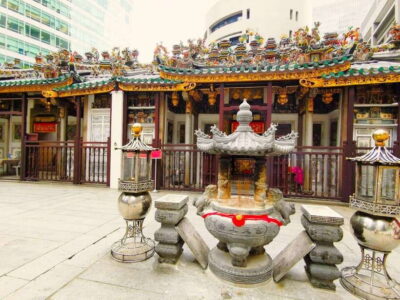
The first scheduled stop is Thian Hock Keng Temple, Singapore’s oldest Hokkien temple. The guide explains its history, architecture, and symbolic meaning in modern Singapore.
This is a strong choice for the opening stop. The temple gives the tour a physical anchor, and the discussion can connect its decorative details to the Hokkien community and to Singapore’s changing society. The supplied information does not list every architectural feature, so you should expect interpretation from the guide rather than a detailed academic lecture.
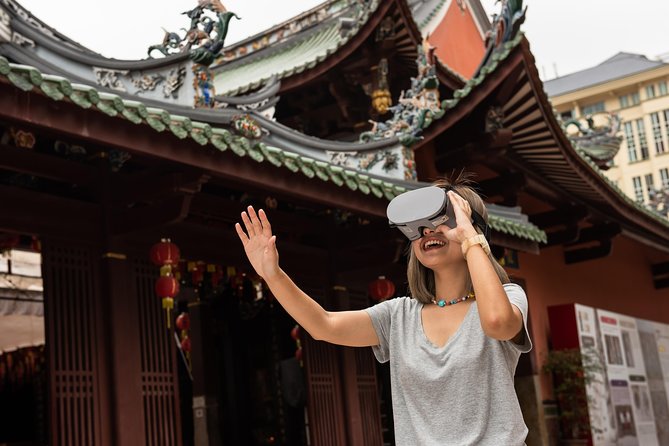
The unusual part comes next. Through virtual reality, you are meant to see and hear a recreated or alternate view connected with the temple. The description refers to state-of-the-art VR and to a sensory experience, but it does not specify the exact headset, length of the session, or what scene you will enter.
That uncertainty is worth keeping in mind. The VR may be the most memorable part for you if you enjoy technology and historical reconstruction. If you find headsets uncomfortable, or if you would rather spend time examining the actual building, this portion may not be your favorite.
The scheduled time here is about 20 minutes, with admission listed as free. Twenty minutes is enough for a focused explanation and a short digital presentation, but not enough for a slow architectural study. I would treat the temple stop as a concise introduction to the tour’s theme: old Singapore explained through new tools.
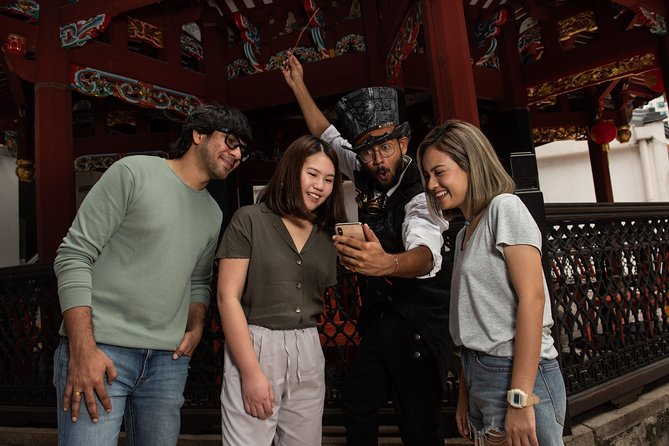
The live performers also feature in the wider experience. They bring characters into the walk and help create a mystery or story. Because the precise scenes are not described, you should expect a theatrical element without assuming a particular plot or historical character.
Singapore City Gallery and the city’s physical story
The second stop is Singapore City Gallery, scheduled for about 15 minutes. Its subject is the physical transformation of Singapore over the past 50 years, along with the planning decisions behind the city and possible future developments.
This stop changes the scale of the tour. At the temple, the focus is religion, community, and architecture. At the gallery, the focus shifts to urban planning and the way Singapore has changed as a city.
Fifteen minutes is brief, so do not expect to examine every display. The value here is the broad context. Singapore’s buildings, roads, housing, and public spaces did not appear by accident. A short introduction to planning can help you understand the contrast between old Chinatown streets and the modern city around them.
I like this stop because it prevents the tour from becoming a collection of disconnected heritage facts. It asks you to consider how historic areas fit into a city that has changed quickly. The drawback is simply time. If urban planning interests you, you may wish for a longer visit than the schedule allows.
Admission is listed as free. Since the tour does not depend on a costly entry ticket at this stop, the $129 price continues to represent the guide, performers, production, and technology rather than entrance fees.
More walking tours around Singapore:
- Singapore: Private Walking Tour with a Local
★ 4.7 · 410 reviews - Private Customised Singapore Walking Tour
★ 5.0 · 370 reviews - Singapore: Chinatown and Little India Guided Walking Tour
★ 4.8 · 190 reviews - Singapore: Customized Private Tours (Car/Bus/Walking)
★ 5.0 · 181 reviews
Sago Lane and the Buddha Tooth Relic Temple
The route then passes along Sago Lane before reaching the Buddha Tooth Relic Temple and Museum. The lane is presented through its difficult former association with death houses, giving the walk a more serious turn.
This detail is important because it shows a less polished side of Chinatown’s past. Heritage districts are not only colorful facades and food stalls. They also contain stories about illness, death, family customs, and the way communities once dealt with the end of life.
The scheduled time for this section is about 10 minutes. That is enough for a brief explanation and a look at the setting, but it is not a long museum visit or a full treatment of Sago Lane’s past. You should expect a compact story that adds weight to the walk.
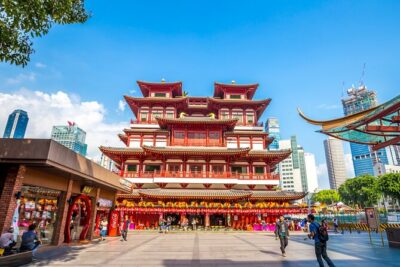
The Buddha Tooth Relic Temple is the route’s best-known visual landmark. Its scale and design provide a strong contrast with the earlier temple stop, while the museum gives the tour another chance to connect religious practice with Singapore’s multicultural society.
The itinerary does not state how much time you spend inside the temple or museum, nor does it list a separate admission charge. Do not plan your whole day around an extended visit unless the operator confirms the timing. The official schedule gives only 10 minutes for this stop.
A finish at Nanyang Old Coffee
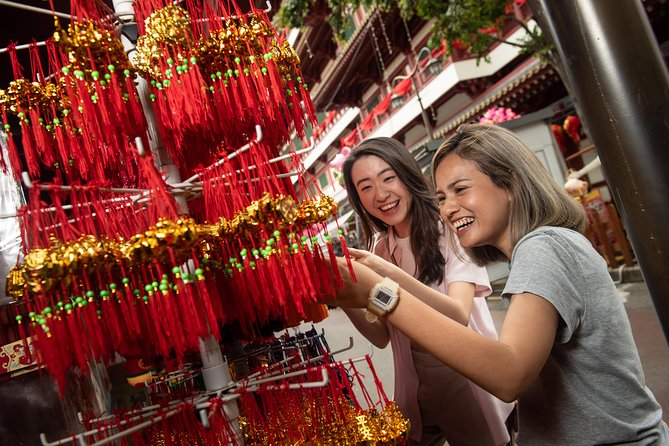
The tour ends on Smith Street, in the heart of Chinatown, at Nanyang Old Coffee. That is a practical finish because you are left in an area with plenty of onward options, although the supplied details do not identify specific transport connections from the endpoint.
Ending at a coffee place also gives the route a clear local-food and social note. The information does not say that a drink or food is included, so you should not assume refreshments are part of the $129 price. Think of Nanyang Old Coffee as the meeting point at the end, not as a guaranteed tasting.
Smith Street is also a good place to continue exploring under your own power. You can finish the tour and then decide if you want more Chinatown time. The route does not return you to Telok Ayer, so remember that the tour is point-to-point.
The published duration is about 2 hours and 30 minutes. The scheduled times for the three named stops add up to 45 minutes, leaving the rest for walking, explanations, live scenes, and technology. Since the exact walking distance and performance timing are not supplied, plan for the full two and a half hours rather than expecting an early finish.
Is $129 a fair price?
At $129, this is an expensive walking tour if you compare it with a basic neighborhood stroll. The three named stops list free admission, and Chinatown itself can be explored without paying for a tour.
The price makes more sense if you specifically want a produced experience with a small group, live performers, and VR. You are paying for the format and the interpretation. The tour attempts to turn familiar sights into a story, which can be useful if you want structure or if you are introducing Singapore to someone who prefers activities over conventional sightseeing.
I would not book it simply to see Thian Hock Keng Temple, Singapore City Gallery, or Buddha Tooth Relic Temple. You can find those places through other means. I would consider it if the combination of technology and live storytelling is the main attraction.
The rating supplied for the experience is 4.4 out of 5 from seven ratings. That is a positive overall score, but the small number of ratings means you should not treat it as a guarantee. The single detailed complaint raises a practical concern about communication before the tour, especially because cancellation is not allowed.
Who will enjoy this format most?
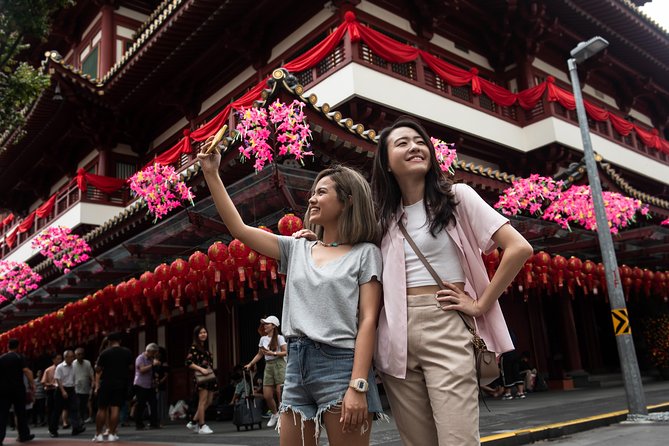
This tour suits you if you like a guided walk but want more than a guide pointing out buildings. Families, first-time visitors, and people who enjoy interactive media may appreciate the mix of characters, VR, and short heritage explanations.
It can also work for you if you have limited time in Singapore. In one route, you receive an introduction to a major temple, city planning, Sago Lane, and Chinatown’s most recognizable temple. The 2.5-hour length leaves room for another activity later in the day.
You may want a different experience if your priority is photography, long temple visits, or a detailed study of architecture. The scheduled stops are short, and the live format means part of your attention will go to the performers and story rather than to quiet observation.
The tour is open to most people, and it is near public transportation. Still, no detailed accessibility information is provided. If you need specific support for walking, standing, or VR use, contact Streets Alive Singapore before paying. The non-refundable terms make that check especially important.
How to prepare for a smoother outing
Before booking, confirm the exact Telok Ayer meeting point. The available information gives the starting area but does not provide a named landmark or a detailed meeting instruction in the material supplied here.
On the day, keep your mobile ticket and booking confirmation easy to reach. Arrive with enough time to find the group, since the tour is limited to 15 people and may not be able to wait for a late arrival.
Plan for the full 2 hours and 30 minutes. The tour involves a guided stroll, and you should be ready for short periods of standing at the temple, gallery, and Buddha Tooth Relic Temple.
Keep your expectations focused. This is a staged cultural walk, not a private research tour. Its strength is the blend of place, performance, and technology. Its weak point is that the short stop times limit how much detail each site can receive.
Should you book Streets Alive Singapore?
Book this tour if you want Chinatown presented as a short live production rather than a plain sightseeing walk. The small group, performers, and VR give it a distinct identity, while the route covers several important places in a compact afternoon.
Skip it if you are mainly looking for low-cost access to the sights, a long temple visit, or a traditional guide-led history walk. The $129 price is hard to justify on admission value alone.
My practical advice is to confirm the meeting point and any questions about VR, walking, and timing before you commit. If that communication is clear and the theatrical format sounds like fun, Streets Alive could be a memorable way to meet Chinatown. If the operator cannot answer basic arrival questions, the strict non-refundable policy makes this a riskier purchase.
FAQ
Where does the Streets Alive Singapore Walking Tour begin?
The tour begins in Telok Ayer, Singapore. The supplied information does not provide a more specific landmark or meeting instruction.
Where does the tour end?
It ends on Smith Street in Chinatown, at Nanyang Old Coffee.
How long does the tour last?
The tour lasts approximately 2 hours and 30 minutes.
How many people can join the tour?
The maximum group size is 15 people.
What sites are included?
The route includes Thian Hock Keng Temple, Singapore City Gallery, Sago Lane, and Buddha Tooth Relic Temple and Museum.
Is admission to the listed stops included?
Admission is listed as free for Thian Hock Keng Temple and Singapore City Gallery. The supplied information does not provide a separate admission detail for Buddha Tooth Relic Temple and Museum.
Does the tour include virtual reality?
Yes. A virtual reality experience is included, with the first stated VR section taking place at Thian Hock Keng Temple.
Does the tour use live performers?
Yes. Live performers appear as characters who interact with the group and help tell the tour’s mystery and story.
Can I cancel or change the booking?
No. The experience is non-refundable and cannot be changed for any reason.
Just added around Singapore
- Skyline Luge and Sky Ride Ticket Sentosa Singapore★ 3.5 · 3 reviews
- Marina Bay Sands SkyPark Observation Deck ticket in Singapore★ 4.0 · 3 reviews
- Singapore Private Full-Day Sightseeing Tour★ 5.0 · 3 reviews
- Singapore: Food and Bike Tour – Downtown★ 4.6 · 3 reviews
- Singapore: Chinatown Street Food Tour★ 5.0 · 3 reviews
- Learn to cook authentic Peranakan food with local market tour★ 3.5 · 3 reviews
- Guided Walking Tour to the Historical Attractions in Farrer Park★ 5.0 · 3 reviews
- Singapore Brompton Bike Tour from Rail Corridor, with food!★ 5.0 · 3 reviews
Chinatown Tours, compared.
Chinatown, Little India, Kampong Gelam City Highlights Tour
Read our review →
Chinatown Hawker Market Food Tour with 7 Food Tastings
Read our review →Chinatown, Little India, Arab Street Walking Tour
Read our review →
Kampong Glam, Little India & Chinatown with Local Street Food Tastings
Read our review →
Browse the lists this tour appears in