Reviewed · TICKETS
Singapore: Singapore Oceanarium Entrance Ticket
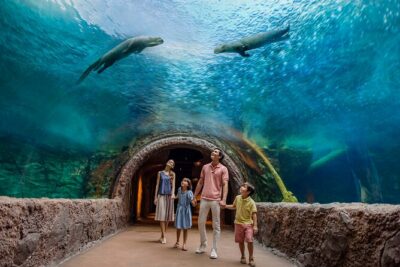
Singapore Oceanarium saves its biggest visual punch for its 36-metre-wide viewing panel, where reef manta rays and zebra sharks move through a broad blue world. Before that, you’ll meet more than 5,000 moon jellyfish, trace marine life’s move onto land, and learn how whale falls feed whole communities in the dark sea.
I especially like the interactive mangrove habitat, which turns a familiar coastal ecosystem into something you can study with your hands and eyes. I also like the chance to slow down beside the large tank, a smart tip if you have time. The main drawback is the price: at $43 per person, this is not a quick stop, and the ticket cannot be refunded.
In This Review
- Key points at a glance
- Starting at Resorts World Sentosa
- The moon jellyfish tank makes an immediate impression
- Mangroves bring the coast within reach
- Marine fossils explain the move from sea to land
- The whale fall exhibit shows life after death
- The giant panel brings together manta rays and zebra sharks
- Education is built into the institution
- How much time should you allow?
- Is the $43 admission good value?
- Who will enjoy this most?
- Practical details before you book
- Should you book Singapore Oceanarium?
- FAQ
- Where is Singapore Oceanarium located?
- How long is the ticket valid?
- How long should I plan to spend inside?
- What is included with the ticket?
- Are food and personal expenses included?
- Is the Oceanarium wheelchair accessible?
- Can I use the ticket during exclusive events?
- Is the ticket refundable?
- Will Singapore Oceanarium be open on 13 June 2026?
Key points at a glance
- More than 5,000 moon jellyfish: One of the world’s largest kreisel tanks creates a slow, hypnotic opening to the visit.
- Mangrove displays you can touch: The interactive habitat gives marine education a practical, hands-on edge.
- Marine evolution in one walk: Life-sized animatronics and fossils explain how ocean life eventually reached land.
- Whale falls in the deep sea: This unusual exhibit shows how a dead whale can support an entire ecosystem.
- A 36-metre viewing panel: Reef manta rays and zebra sharks provide the grand finale for many visitors.
- A useful rainy-day plan: Allow about two and a half hours, or longer if you sit by the large tank.
Starting at Resorts World Sentosa
Singapore Oceanarium is at Resorts World Sentosa, so you make your own way there and proceed directly to the entrance for ticket redemption. There is no guided tour, transfer, meal, or personal expense included. You receive admission for one day during regular park hours.
That simple setup suits an independent day out. You are not tied to a group or a guide’s pace. You can move quickly through familiar displays, then spend real time at the tanks that catch your eye.
Check operating hours before you go. Hours can change without notice, and the ticket is not valid for exclusive events. The Oceanarium will also be closed to the public on 13 June 2026, an important date to check if it affects your plans.
I would set aside at least two and a half hours. That is enough time for a steady walk through the main exhibits and a pause at the large tank. If you read every display, stop for food, or visit with children, plan for more time.
A few more Singapore days out worth weighing up
- Singapore: Gardens by the Bay Bundle Entry Ticket
★ 4.3 · 3,726 reviews - Singapore: Singapore Flyer Entry Ticket
★ 4.7 · 907 reviews - Singapore: Sentosa Wings of Time Fireworks Symphony Ticket
★ 4.3 · 321 reviews
The moon jellyfish tank makes an immediate impression
The moon jellyfish display is one of the clearest reasons to buy this ticket. More than 5,000 jellyfish move through one of the world’s largest kreisel tanks, a circular tank designed to keep water flowing gently around the animals.
The effect is quiet and striking. Instead of one large creature doing the work, the display depends on scale and movement. The jellyfish drift, pulse, and catch the light as a huge group.
I would not rush past this area. It offers a useful change of pace from the larger animal displays, and it gives you a chance to watch a simple movement pattern become almost abstract. It is also a good stop if you prefer calm exhibits over loud or highly technical presentations.
The tank is not just a photo backdrop. Its size helps you understand the scale needed to keep a large number of delicate animals in a suitable habitat. That makes the display more useful than a small jellyfish tank tucked into a side room.
Mangroves bring the coast within reach
The interactive mangrove habitat gives the Oceanarium a strong local connection. Mangroves sit between land and sea, protecting shorelines and providing shelter for many forms of life. Here, touch-friendly biodiversity displays let you examine the subject in a direct way.
That hands-on element matters. Mangroves can seem like a background feature when you see them from a distance, but the display helps you notice the variety of life linked to them. It also gives younger visitors something active to do, rather than asking them to read long panels from start to finish.
I like this part because it connects the large tanks to a real coastal environment. The Oceanarium is not only about spectacular animals in enormous water-filled rooms. It also shows how smaller habitats support much larger systems.
You should still keep expectations sensible. The information provided does not list specific animals or activities within the mangrove section, so I would treat it as an interactive learning stop rather than expect a particular creature encounter.
Marine fossils explain the move from sea to land
The next major theme follows marine evolution and the transition of life onto land. Life-sized animatronics and fossils help turn a large scientific idea into something you can picture.
Fossils provide evidence of change over time, while life-sized models help you imagine the animals behind that evidence. Together, they make this section accessible even if you do not have a background in biology.
This is a useful bridge between the living habitats. You begin with present-day marine life, then step back to consider how life changed across long periods. The point is not simply that the ocean contains unusual animals. It is that the ocean is tied to the story of life on Earth.
The animatronics may appeal most to families, but the fossil displays give adults a reason to slow down as well. I would read the key panels here instead of treating this section as a corridor between tanks.
A different sort of day out, same city:
- Lion City Bike Tour of Singapore
★ 5.0 · 6,211 reviews - Singapore: Big Bus Hop-On Hop-Off Tour by Open-Top Bus
★ 4.5 · 3,261 reviews - Singapore: Lion City Highlights Bike Tour
★ 4.9 · 2,010 reviews - Small Group: Michelin and Local Hawker Food Tour with 9 tastings
★ 5.0 · 1,890 reviews
The whale fall exhibit shows life after death
The deep-sea section focuses on whale falls, the remains of whales that settle on the ocean floor and support entire ecosystems. It is an unusual subject for an aquarium, and that is precisely why it earns attention.
Many aquarium exhibits focus on living animals and bright shallow reefs. A whale fall explains what happens when a huge animal becomes part of the sea floor. The remains can provide food and shelter for other organisms, creating a community in a place that otherwise seems empty and remote.
This exhibit adds useful balance to the visit. You see the ocean not only as a place of beauty, but also as a system built on cycles of life, death, and renewal. It may be less instantly flashy than the jellyfish or manta rays, but it gives the visit some of its best scientific context.
I would allow extra time if you enjoy unusual natural-history subjects. The supplied information does not specify the exact format of the display, so I would expect a themed exhibit rather than assume a live deep-sea animal presentation.
The giant panel brings together manta rays and zebra sharks
The 36-metre-wide panel is likely to be the Oceanarium’s grandest visual space. Reef manta rays and zebra sharks move through the display, giving you two very different animals to watch in the same broad habitat.
The width changes how you view the animals. Rather than waiting for one creature to pass a small window, you can scan a large area and follow several movements at once. That makes this a place to pause, not merely walk past.
A useful tip is to get a snack near the large tank and sit for a while. The advice is practical because large aquarium windows reward patience. You may notice different animals only after standing or sitting quietly for several minutes.
This is also the point where the $43 admission begins to make more sense. If you spend only a few minutes in each area, the cost can feel high. If you use the day to watch the major tank, read the evolution displays, and take in the smaller habitats, you receive a fuller visit.
Education is built into the institution
Singapore Oceanarium describes itself as an ocean institute, not only an entertainment venue. Its stated work includes marine education, research, and conservation, with a focus on threatened species and ocean action.
You can see that purpose in the way the experience combines live habitats, ocean stories, digital tools, and interactive technology. The exact level of access to each research area is not specified, so I would not expect a behind-the-scenes laboratory visit with this admission ticket.
The site also includes a Research and Learning Centre. It is designed for conservation, research, and community engagement, and it has Green Mark Platinum Zero Energy certification from Singapore’s Building and Construction Authority. The centre operates fully on solar power.
That sustainability detail adds meaning to the visit. It does not make the ticket cheaper, but it shows that the institution is considering energy use as part of its public mission. The value here is strongest for people who want an aquarium visit to include conservation thinking, not just animal viewing.
Singapore Oceanarium also has accreditation from the Association of Zoos and Aquariums and memberships in the World Association of Zoos and Aquariums and the Southeast Asian Zoo and Aquarium Association. Those affiliations indicate a connection to wider professional networks, although they should not be read as a promise that every display will suit every visitor.
How much time should you allow?
The ticket is valid for one day, but most people will not need an entire day inside the Oceanarium. A visit of around two and a half hours gives you a practical target.
I would use the time in three stages:
- Start with the jellyfish and mangrove habitats, where you can settle into the visit and explore at a relaxed pace.
- Give the evolution and whale fall sections enough time to read and think about the ideas, not just the images.
- Finish with the 36-metre panel, then sit near the large tank with a snack if you want to watch the animals for longer.
The one-day validity gives you flexibility, but the ticket does not include other personal expenses. Food, drinks, and anything else you buy are extra.
A rainy day is a particularly sensible time to visit. One person spent about two and a half hours there during wet weather and found it a strong way to use the day. Singapore’s rain can disrupt outdoor plans quickly, so an indoor attraction at Resorts World Sentosa gives you a dependable alternative.
Is the $43 admission good value?
At $43 per person, this is a premium aquarium visit. I would not call it a bargain, especially if you plan only a short walk through the exhibits.
The price becomes easier to justify if you care about scale and variety. You receive access to the giant moon jellyfish tank, interactive mangrove material, evolutionary displays, the whale fall section, and the large manta ray and zebra shark panel. These are not all variations of the same exhibit.
The visit also has educational value that goes beyond animal identification. You learn about habitats, evolution, deep-sea systems, and conservation. That makes it more useful for families, school-age children, and adults who want some meaning behind the spectacle.
Still, the rating of 3.8 from 30 reviews suggests the experience may not delight everyone equally. That is fair. Some people expect a huge aquarium to fill most of a day, while the practical visit length appears closer to a few hours. If your main goal is a quick look at sharks, you may find the cost hard to defend.
My advice is to buy it when you can give the Oceanarium time. Treat it as a focused indoor attraction, not a ten-minute photo stop.
Who will enjoy this most?
I would recommend Singapore Oceanarium to families who want a mix of visual displays and simple science. The touch-friendly mangrove material and life-sized animatronics should help younger visitors stay involved, while the large tanks give adults plenty to watch.
It also suits anyone building a rainy-day plan in Singapore. You can spend a couple of hours indoors without needing a full tour schedule or a guide.
Ocean lovers will get the most from the visit, especially if they enjoy sitting quietly at a tank and watching animal movement. The manta rays, zebra sharks, and moon jellyfish provide the strongest visual appeal.
You may want to skip it if you dislike aquariums, prefer fast-paced attractions, or are comparing admission prices very closely. The ticket is non-refundable, so you should be confident that marine exhibits are worth your time before booking.
The venue is wheelchair accessible. You still need to follow posted rules and guidelines, since failure to do so can lead to injury or removal from the facility.
Practical details before you book
This is a self-guided admission ticket. Proceed directly to Singapore Oceanarium for redemption, and check availability for the starting times shown for your chosen date.
The ticket works during regular park hours only. It does not cover exclusive events, and operating hours can change without notice.
There is no named guide because this is not a guided excursion. The provider is GlobalTix Pte Ltd, but the visit itself is your own walk through the Oceanarium.
The activity is non-refundable. Keep that in mind when planning around weather, illness, or changes to your schedule. Rain makes the attraction a good backup plan, but it does not change the cancellation conditions.
Should you book Singapore Oceanarium?
Book it if you want a large-scale aquarium visit with more than pretty tanks. The jellyfish, whale fall, fossil, mangrove, manta ray, and zebra shark displays offer enough variety for a thoughtful two-and-a-half-hour visit.
I would especially choose it for a wet Singapore day, a family outing, or a trip that already includes Resorts World Sentosa. Plan time to sit by the large panel, since that is where patience pays off.
Skip it if $43 feels too high for a few hours indoors or if you want a guided conservation tour with personal commentary. For the right visitor, the ticket buys a well-designed look at ocean life and the systems that support it. For everyone else, it may feel like an expensive aquarium stop.
FAQ
Where is Singapore Oceanarium located?
Singapore Oceanarium is located at Resorts World Sentosa in Singapore.
How long is the ticket valid?
The admission ticket is valid for one day.
How long should I plan to spend inside?
A practical visit can take about two and a half hours, though you may stay longer if you read the displays carefully, stop for a snack, or sit by the large tank.
What is included with the ticket?
The ticket includes admission to Singapore Oceanarium.
Are food and personal expenses included?
No. Other personal expenses are not included.
Is the Oceanarium wheelchair accessible?
Yes, the activity is wheelchair accessible.
Can I use the ticket during exclusive events?
No. The ticket is valid only during regular park hours and is not valid for exclusive events.
Is the ticket refundable?
No. This activity has a non-refundable cancellation policy.
Will Singapore Oceanarium be open on 13 June 2026?
No. The Oceanarium will be closed to the public on 13 June 2026.
Just added around Singapore
- Skyline Luge and Sky Ride Ticket Sentosa Singapore★ 3.5 · 3 reviews
- Marina Bay Sands SkyPark Observation Deck ticket in Singapore★ 4.0 · 3 reviews
- Singapore Private Full-Day Sightseeing Tour★ 5.0 · 3 reviews
- Singapore: Food and Bike Tour – Downtown★ 4.6 · 3 reviews
- Singapore: Chinatown Street Food Tour★ 5.0 · 3 reviews
- Learn to cook authentic Peranakan food with local market tour★ 3.5 · 3 reviews
- Singapore Brompton Bike Tour from Rail Corridor, with food!★ 5.0 · 3 reviews
- Guided Walking Tour to the Historical Attractions in Farrer Park★ 5.0 · 3 reviews
Tickets, compared.


Sentosa Wings of Time Fireworks Symphony Ticket
Read our review →